
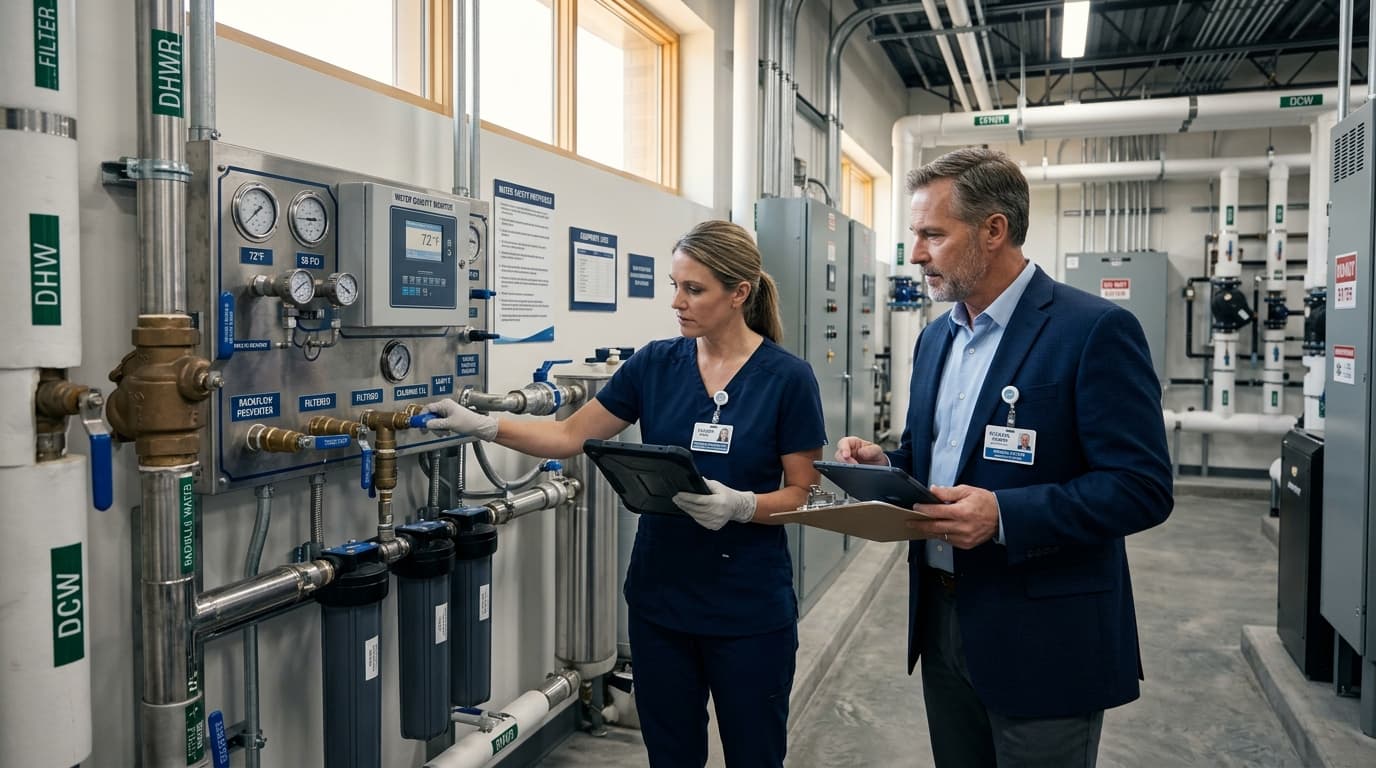
Water management is an area of nursing-home operations that can easily be overlooked until there is a problem.
For Nursing Home Administrators, water management should not be viewed as simply a maintenance responsibility. It is an important component of infection prevention, resident safety, environmental safety, and regulatory compliance.
The Centers for Disease Control and Prevention (CDC) recommends that healthcare facilities develop and implement comprehensive water management programs to reduce the risk of Legionella growth and transmission and to address other opportunistic waterborne pathogens.
“Water safety is not just an engineering checklist; it is an active infection control priority. A failure in building water systems poses an immediate threat to vulnerable residents and constitutes a major regulatory vulnerability.”
What Should an NHA Know About the Facility’s Water Management Program?
A nursing home should have a structured, living process that addresses the building’s complex water systems and identifies conditions that could allow pathogens to grow and spread.
The CDC identifies seven major steps for developing and maintaining an effective water management program:
Establish a Water Management Team
Form a dedicated multidisciplinary committee with clear accountability, decision-making authority, and scheduled recurring reviews.
Describe the Building Water Systems
Develop detailed process flow diagrams identifying hot and cold distribution networks, boilers, storage tanks, softeners, fixtures, and cooling towers.
Identify Areas of Pathogen Growth & Spread
Pinpoint vulnerable zones where biofilm forms, water stagnates (dead legs), temperatures fluctuate into hazardous ranges (77°F to 113°F), or aerosols are generated.
Establish & Monitor Control Measures
Define specific control limits and systematic monitoring schedules for temperature, disinfectant residual levels, pH, and supplemental biocide regimens.
Establish Corrective Actions for Breaches
Predetermine exact immediate protocols and remediation steps when control limits are not met, including retesting, flushing, and root-cause analysis.
Verify Effective Program Operation
Validate that the program is being executed exactly as written and confirm that control measures successfully keep waterborne pathogens in check.
Document & Communicate All Activities
Maintain complete, contemporaneous logs of all monitoring data, corrective actions, equipment servicing, team meetings, and leadership reporting.
Key Takeaway: These steps require ongoing, disciplined monitoring and review rather than simply having a policy sitting on a shelf in a binder.
Who Should Be Involved? A Multidisciplinary Foundation
Water management should be multidisciplinary. Safe water operations cannot be delegated solely to the maintenance technician down in the mechanical room.
Depending on the facility's size, operational complexity, and resident acuity, the team should include:
Executive oversight, resource allocation, and regulatory compliance.
Clinical risk evaluation, resident vulnerability oversight, and symptom surveillance.
Epidemiological surveillance, infection control audits, and CDC guideline alignment.
Physical plant operation, fixture flushing schedules, filter changes, and daily testing.
Staff education, resident care protocol adherence, and clinical feedback loops.
Mechanical diagnostics, backflow prevention, plumbing integrity, and boiler operations.
Certified water-treatment specialists, accredited third-party laboratories, and environmental engineering consultants.
CDC’s current healthcare guidance emphasizes multidisciplinary involvement, documentation, monitoring, corrective actions, and ongoing evaluation of the program.
What Should the NHA Ask? An Administrator’s Walkthrough Guide
When I walk into a nursing home, I would want to know:
The Executive Water Safety Audit Checklist
- • Do we have a current water management program? Is it active, reviewed at least annually, and understood by both frontline staff and supervisory leadership?
- • When was the facility’s water-system risk assessment completed? Was it executed recently, and does it account for all high-risk resident clinical populations?
- • Who is on the water management team? Are meetings held regularly, with documented attendance, actionable agendas, and recorded minutes?
- • What parameters are being monitored? Are disinfectant residuals (chlorine/chloramine), temperatures at points of use, and pH levels routinely recorded across distal sites?
- • What happens when a control limit is not met? Is there an immediate, predetermined operational response plan, or does the facility scramble to figure out next steps?
- • Are corrective actions documented and followed through? Can the team demonstrate closed-loop verification, remediation flushing, retesting, and root-cause analysis?
- • Has the program been reviewed when there are renovations, plumbing changes, water interruptions, or other significant changes to the building?
The CDC notes that water management programs must be tailored to the specific building because factors such as building age, size, water-system components, surrounding conditions, and the people using the building can significantly affect risk.
Don't Confuse a Policy with an Effective Process
This is an indispensable leadership lesson.
A facility may have an impressive water-management policy sitting in a neat binder in the maintenance office. But the real operational question is:
“Is the process actually being implemented on the floor every single day?”
When state surveyors or corporate auditors review your facility, can the team demonstrate concrete answers to these questions:
Accountability & Parameters
- Who is responsible? Explicit roles assigned to staff positions rather than isolated individuals.
- What is being monitored? Exact testing points, chemical thresholds, and water temperatures.
- How frequently is it monitored? Clear daily, weekly, and monthly monitoring frequencies.
- What are the established control limits? Scientifically established acceptable ranges.
Response, Audit & Closure
- What happens when outside acceptable range? Clear, non-negotiable remediation triggers.
- Who reviews the results? Interdisciplinary oversight and QAPI integration.
- Where is the documentation? Centralized, contemporaneous, easily retrievable records.
- How are findings communicated? Rapid escalation across maintenance, clinical, and leadership.
- How does leadership know it was effective? Verified post-remediation data proving resolution.
CMS Regulatory Expectations
CMS expects Medicare- and Medicaid-certified healthcare facilities to have water-management policies and procedures addressing the risk of Legionella and other opportunistic waterborne pathogens. CMS guidance also references facility risk assessment, a comprehensive water management program, and consideration of CDC and ASHRAE guidance.
The NHA’s Role: Strategic Leadership & Operational Oversight
The Nursing Home Administrator does not need to be the facility's plumbing expert. You do not have to personally adjust thermostatic mixing valves or calibrate disinfectant pumps.
However, the NHA does need to understand the system well enough to provide effective leadership oversight.
Water safety involves multiple departments, and the administrator should ensure that:
- Responsibilities are clearly and consistently assigned.
- Staff members are thoroughly educated on protocols and reporting expectations.
- Documentation is maintained with rigorous accuracy.
- Identified problems are promptly and effectively addressed.
The CDC’s 2026 healthcare guidance also emphasizes that water can carry pathogens that threaten patient safety and recommends maintaining a water management program and conducting a water infection-control risk assessment appropriate to the facility.
A Question for Fellow NHAs
If you walked into a new nursing home tomorrow and asked to see its Water Management Program, would the facility be able to immediately show you:
The plan, the risk assessment, the water-management team, monitoring records, corrective actions, and evidence that the program is actually being implemented?
A policy in a binder is not the same thing as an effective operational process.
Good leadership means knowing the difference.
Kay Ogedengbe, LNHA, MHA, DHA Candidate
Founder & Principal Consultant | Kay Consulting Group, LLC
Kay Consulting Group provides interim healthcare leadership and operational support to long-term care organizations.
References
- Centers for Disease Control and Prevention (CDC). Water Management in Healthcare Facilities. (CDC)
- Centers for Disease Control and Prevention (CDC). Overview of Water Management Programs. (CDC)
- Centers for Disease Control and Prevention (CDC). (February 6, 2026). Considerations for Reducing Risk: Water in Healthcare Facilities. (CDC)
- Centers for Medicare & Medicaid Services (CMS). Requirement to Reduce Legionella Risk in Healthcare Facility Water Systems to Prevent Cases and Outbreaks of Legionnaires’ Disease. (Centers for Medicare & Medicaid Services)
- Centers for Disease Control and Prevention (CDC). Developing a Legionella Water Management Program: A Practical Guide to Implementing Industry Standards. (CDC)